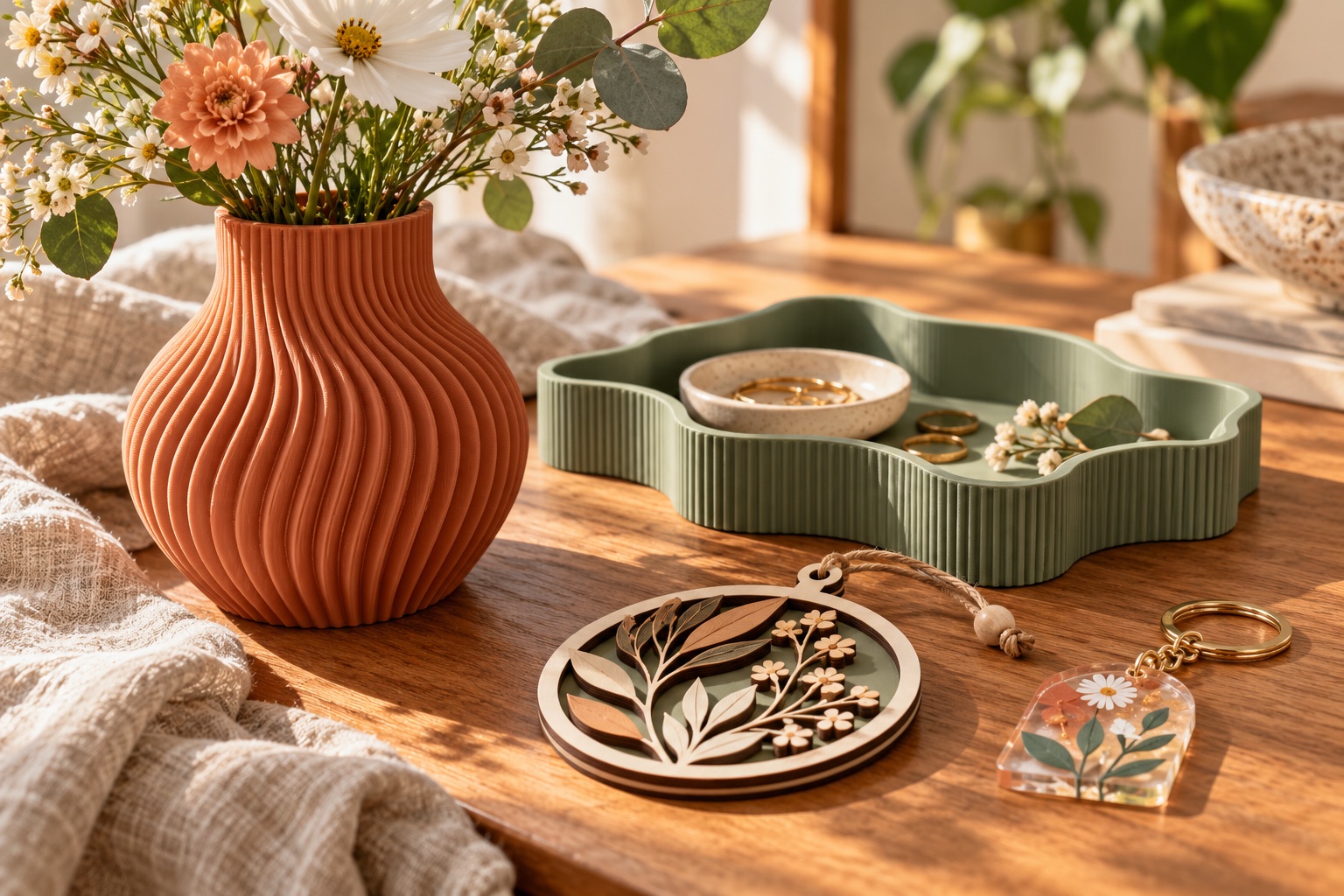
Some of the best 3D-printing ideas solve a small, specific problem: a tray that fits your desk, a display stand for a collection, or a holder sized for the tools you use every day. A clear brief helps turn that idea into a useful object.
Measure the space it needs to fit Record the dimensions of the object or space, including clearance for fingers, cables, or nearby parts. Photos with a ruler are a helpful starting point; exact measurements are better for fitted pieces.
Choose function before finish Tell us whether the object is decorative, handled regularly, or expected to hold weight. Material, wall thickness, orientation, and construction need to suit its use. A decorative print is not automatically suitable for heat, outdoor exposure, food contact, or demanding loads.
Design with the printing process in mind Layer lines, supports, and orientation affect appearance. Rounded corners, accessible openings, and simple assembly can make a useful piece easier to produce. Multi-color printing adds options, but the palette and color transitions should be intentional.
Make a prototype before a batch For a fitted or functional object, test the dimensions and handling with a sample. Adjust the design before committing to a larger run. Keep notes on what changed so the next version is repeatable.
Give credit and check permissions If your idea starts with someone else’s model, share its source and license. A publicly available download does not automatically give permission to sell printed copies.
The Bambu Lab P2S community is one source of discussion and project inspiration. This article is a planning guide; it is not a machine review or a tested print profile.